
Institute Publications
P vs. NP and the Difficulty of Computation: A Ruliological Approach
Stephen Wolfram
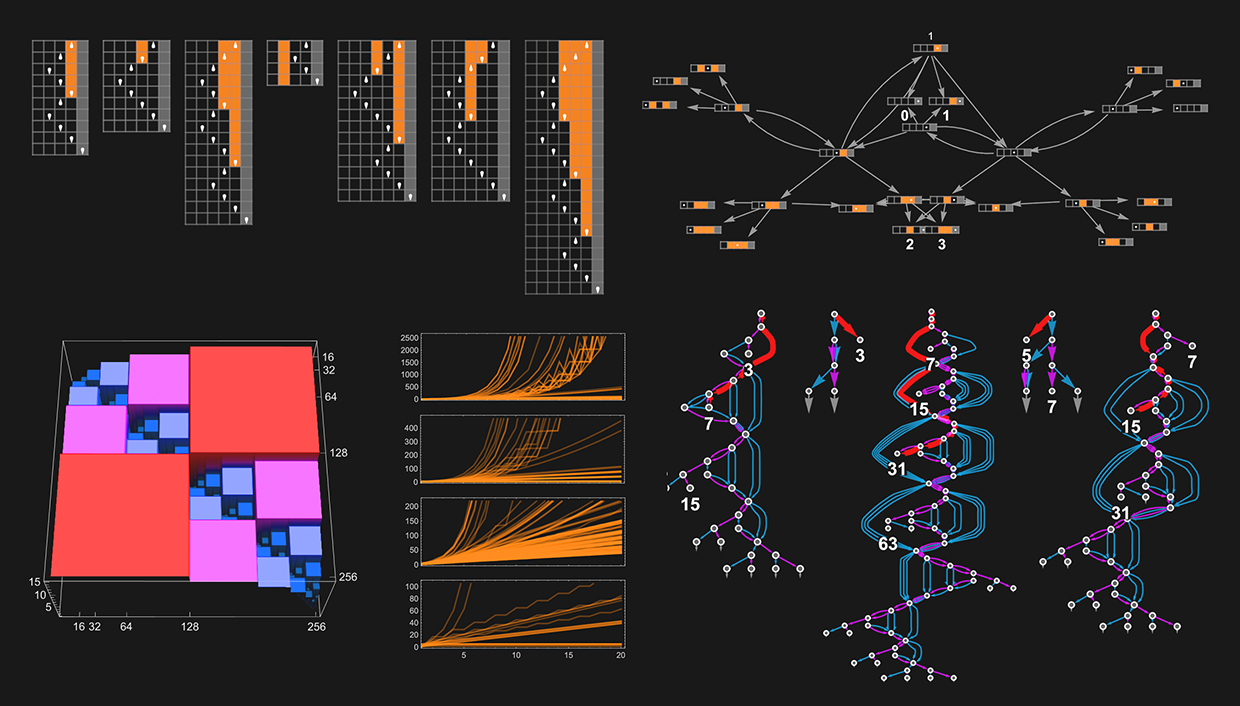
“Could there be a faster program for that?” It’s a fundamental type of question in theoretical computer science. But except in special cases, such a question has proved fiendishly difficult to answer. And, for example, in half a century, almost no progress has been made even on the rather coarse (though very famous) P vs. NP question—essentially of whether for any nondeterministic program there will always be a deterministic one that is as fast. From a purely theoretical point of view, it’s never been very clear how to even start addressing such a question. But what if one were to look at the question empirically, say in effect just by enumerating possible programs and explicitly seeing how fast they are, etc.?

Multiway Turing Machines
Stephen Wolfram
Over the years I’ve studied the simplest ordinary Turing machines quite a bit, but I’ve barely looked at multiway Turing machines (also known as nondeterministic Turing machines or NDTMs). Recently, though, I realized that multiway Turing machines can be thought of as “maximally minimal” models both of concurrent computing and of the way we think about quantum mechanics in our Physics Project. So now this piece is my attempt to “do the obvious explorations” of multiway Turing machines.