
Institute Publications
What Ultimately Is There? Metaphysics and the Ruliad
Stephen Wolfram
“What ultimately is there?” has always been seen as a fundamental—if thorny—question for philosophy, or perhaps theology. But despite a couple of millennia of discussion, I think it’s fair to say that only modest progress has been made with it. But maybe, just maybe, this is the moment where that’s going to change—and on the basis of surprising new ideas and new results from our latest efforts in science, it’s finally going to be possible to make real progress, and in the end to build what amounts to a formal, scientific approach to metaphysics.
P vs. NP and the Difficulty of Computation: A Ruliological Approach
Stephen Wolfram
“Could there be a faster program for that?” It’s a fundamental type of question in theoretical computer science. But except in special cases, such a question has proved fiendishly difficult to answer. And, for example, in half a century, almost no progress has been made even on the rather coarse (though very famous) P vs. NP question—essentially of whether for any nondeterministic program there will always be a deterministic one that is as fast. From a purely theoretical point of view, it’s never been very clear how to even start addressing such a question. But what if one were to look at the question empirically, say in effect just by enumerating possible programs and explicitly seeing how fast they are, etc.?
What Is Ruliology?
Stephen Wolfram
Ruliology is taking off! And more and more people are talking about it. But what is ruliology? Since I invented the term, I decided I should write something to explain it. But then I realized: I actually already wrote something back in 2021 when I first invented the term. What I wrote back then was part of something longer. But here now is the part that explains ruliology.
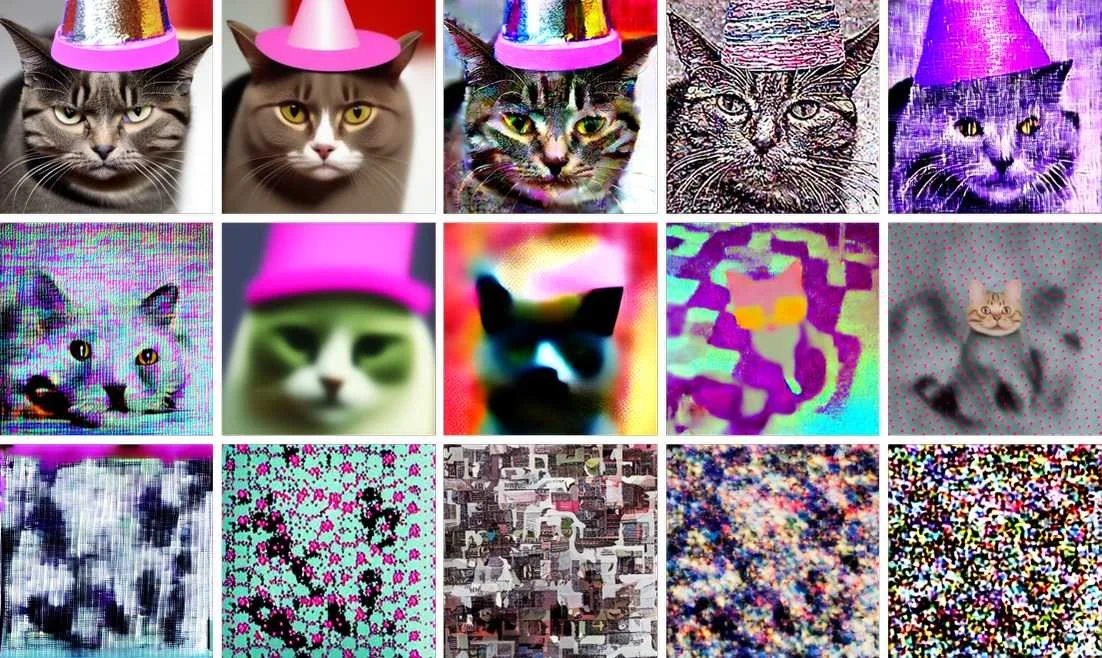
Generative AI Space and the Mental Imagery of Alien Minds
Stephen Wolfram
How do alien minds perceive the world? It’s an old and oft-debated question in philosophy. And it now turns out to also be a question that rises to prominence in connection with the concept of the ruliad that’s emerged from our Wolfram Physics Project.

Alien Intelligence and the Concept of Technology
Stephen Wolfram
“We’re going to launch lots of tiny spacecraft into interstellar space, have them discover alien intelligence, then bring back its technology to advance human technology by a million years”.
But as I thought about it, I realized that beyond the “absurdly extreme moonshot” character of this pitch, there’s some science that I’ve done that makes it clear that it’s also fundamentally philosophically confused. The nature of the confusion is interesting, however, and untangling it will give us an opportunity to illuminate some deep features of both intelligence and technology—and in the end suggest a way to think about the long-term trajectory of the very concept of technology and its relation to our universe.

The Concept of the Ruliad
Stephen Wolfram
I call it the ruliad. Think of it as the entangled limit of everything that is computationally possible: the result of following all possible computational rules in all possible ways. It’s yet another surprising construct that’s arisen from our Physics Project. And it’s one that I think has extremely deep implications—both in science and beyond.

Exploring Rulial Space: The Case of Turing Machines
Stephen Wolfram
Let’s say we find a rule that reproduces physics. A big question would then be: “Why this rule, and not another?” I think there’s a very elegant potential answer to this question, that uses what we’re calling rule space relativity—and that essentially says that there isn’t just one rule: actually all possible rules are being used, but we’re basically picking a reference frame that makes us attribute what we see to some particular rule. In other words, our description of the universe is a sense of our making, and there can be many other—potentially utterly incoherent—descriptions, etc.